Fluclotizolam
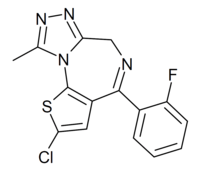
Fluclotizolam is a thienotriazolodiazepine derivative which was first synthesised in 1979,[1] but was never marketed. It has subsequently been sold as a designer drug, first being definitively identified in 2017.[2][3][4]
 | |
| Legal status | |
|---|---|
| Legal status |
|
| Identifiers | |
IUPAC name
| |
| PubChem CID | |
| Chemical and physical data | |
| Formula | C15H10ClFN4S |
| Molar mass | 332.78 g·mol−1 |
| 3D model (JSmol) | |
SMILES
| |
InChI
| |
See also
References
- Hellerbach J, et al. Thienotriazolodiazepine derivatives. Patent US 4155913
- Zawilska JB, Wojcieszak J. An expanding world of New Psychoactive Substances – Designer benzodiazepines. NeuroToxicology 2019 July; 73: 8-16. doi:10.1016/j.neuro.2019.02.015
- Moosmann B., Auwärter V. (2018) Designer Benzodiazepines: Another Class of New Psychoactive Substances. In: Maurer H., Brandt S. (eds) New Psychoactive Substances. Handbook of Experimental Pharmacology, vol 252. doi:10.1007/164_2018_154
- Chetraru E, Ameline A, Gheddar L, Raul JS, Kintz P. Les designer benzodiazepines: qu’en sait-on aujourd’hui?. Toxicologie Analytique et Clinique. 2018 Feb 1;30(1):5-18. doi:10.1016/j.toxac.2017.12.001
| Alcohols |
|
|---|---|
| Barbiturates |
|
| Benzodiazepines |
|
| Carbamates | |
| Flavonoids |
|
| Imidazoles | |
| Kava constituents |
|
| Monoureides |
|
| Neuroactive steroids |
|
| Nonbenzodiazepines | |
| Phenols | |
| Piperidinediones | |
| Pyrazolopyridines | |
| Quinazolinones | |
| Volatiles/gases |
|
| Others/unsorted |
|
See also: Receptor/signaling modulators • GABA receptor modulators • GABA metabolism/transport modulators | |
This article is issued from
Wikipedia.
The text is licensed under Creative
Commons - Attribution - Sharealike.
Additional terms may apply for the media files.