Centalun
Centalun was developed by Boehringer Ingelheim in 1962[1] and is a psycholeptic drug with hypnotic and sedative effects, via allosteric agonism of the GABAA receptor.[2] It was previously used for sedation in medical procedures such as surgery,[3] orthopedics[4] and gynecology,[5] although it is no longer in clinical use. Despite its history of clinical use, centalun was never incorporated into the CSA and therefore remains unregulated as a drug of abuse.
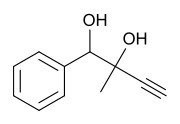 | |
| Clinical data | |
|---|---|
| ATC code |
|
| Legal status | |
| Legal status |
|
| Identifiers | |
IUPAC name
| |
| CAS Number | |
| PubChem CID | |
| ChemSpider | |
| Chemical and physical data | |
| Formula | C11H12O2 |
| Molar mass | 176.212 g/mol g·mol−1 |
| 3D model (JSmol) | |
SMILES
| |
InChI
| |
  | |
References
- BE Patent 618130 'Procédé pour l'obtention d'alkinediols'
- Janke, W.; Glathe, H. (1964). "Experimental Studies on the Psychic Effect of Sedatives Under Normal and Stress Conditions". Psychologische Forschung. 27: 377–402. PMID 14233519.
- Monecke, K. (1964). "Pre- and Postoperative Use of Centalun in Surgery". Deutsches medizinisches Journal. 15: 470–471. PMID 14238754.
- Bruckschen, E. (1964). "Sedative Therapy with Centalun in Orthopedics". Deutsches medizinisches Journal. 15: 493–494. PMID 14243120.
- Gerlach, W.; Gerlach, E. (1964). "Experiences with Centalun in Obstetrical and Gynecological Patients". Medizinische Monatsschrift. 18: 131–133. PMID 14193290.
This article is issued from
Wikipedia.
The text is licensed under Creative
Commons - Attribution - Sharealike.
Additional terms may apply for the media files.