Tribromoethanol
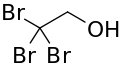
Tribromoethanol is an organobromine compound used as an anesthetic. It is used to anesthetize laboratory animals, particularly rodents, before surgery.[2] As a solution in tert-amyl alcohol, it has the brand name Avertin.[3] The tert-amyl alcohol acts as a weak hypnotic, in addition to improving the solubility of the tribromoethanol. Administered intravenously, tribromoethanol (Avertin) causes rapid and deep anesthesia followed by rapid and full postoperative recovery in small mammals.[4]
 | |
| Clinical data | |
|---|---|
| Trade names | Avertin |
| Other names | Tribromoethyl alcohol |
| Identifiers | |
IUPAC name
| |
| CAS Number | |
| PubChem CID | |
| ChemSpider | |
| CompTox Dashboard (EPA) | |
| ECHA InfoCard | 100.000.822  |
| Chemical and physical data | |
| Formula | C2H3Br3O |
| Molar mass | 282.757 g·mol−1 |
| 3D model (JSmol) | |
| Melting point | 73–79 °C (163–174 °F) [1] |
| Boiling point | 92–93 °C (198–199 °F) at 10 mmHg[1] |
SMILES
| |
InChI
| |
In the first half of the 20th century, Avertin was also used in humans as a general anesthetic or basal narcotic to induce unconsciousness prior to the administration of other anesthetic agents. It was administered rectally as a retention enema or by intravenous injection. Its rectal use was particularly favored for pediatrics, head or neck surgery, or in mentally unstable or anxious patients.[5] Electrophysiology studies showed that tribromoethanol acts as a positive allosteric modulator of the inhibitory GABAA and glycine receptors, a mechanism similar to that seen with the related compound 2,2,2-trichloroethanol.[6] Bromal hydrate (2,2,2-tribromoethanol-1,1-diol), a compound also recognized to produce general anesthesia in animals, is metabolized to tribromoethanol.[7]
See also
References
- "2,2,2-Tribromoethanol". Sigma-Aldrich.
- "Tribromoethanol (Avertin)". Cold Spring Harbor Protocols. Cold Spring Harbor Laboratory. 2006: pdb.rec701. 2006. doi:10.1101/pdb.rec701.
- "Guidelines for the Use of Tribromoethanol/Avertin Anesthesia" (PDF). National Cancer Institute.
- Weiss, J.; Zimmermann, F. (1999). "Tribromoethanol (Avertin) as an anaesthetic in mice". Laboratory Animals. 33 (2): 192–193. doi:10.1258/002367799780578417. PMID 10780824.
- G Edwards (1945). "Tribromethyl alcohol (avertin, bromethol), 1928-1945". Proceedings of the Royal Society of Medicine. 39 (2): 71–76. doi:10.1177/003591574503900203. PMID 21010258.
- M.D. Krasowski & N.L. Harrison (2000). "The actions of ether, alcohol and alkane general anaesthetics on GABAA and glycine receptors and the effects of TM2 and TM3 mutations". British Journal of Pharmacology. 129 (4): 731–743. doi:10.1038/sj.bjp.0703087. PMC 1571881. PMID 10683198.
- Lehman G and Knoefel PK (1938). Trichloroethanol, tribromoethanol, chloral hydrate, and bromal hydrate. J Pharmacol Exp Ther, 63: 453-465.