Brophebarbital
Brophebarbital is a barbiturate derivative. It has sedative and hypnotic effects and is considered to have a moderate abuse potential.[1]
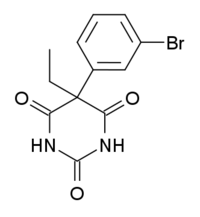 | |
| Clinical data | |
|---|---|
| Other names | Brophebarbital |
| ATC code |
|
| Identifiers | |
IUPAC name
| |
| CAS Number | |
| ChemSpider |
|
| Chemical and physical data | |
| Formula | C12H11BrN2O3 |
| Molar mass | 311.131 g/mol g·mol−1 |
| 3D model (JSmol) | |
SMILES
| |
InChI
| |
  | |
References
- Eddy, N. B.; Halbach, H.; Isbell, H.; Seevers, M. H. (1965). "Drug dependence: Its significance and characteristics". Bulletin of the World Health Organization. 32 (5): 721–733. PMC 2555251. PMID 5294186.
| Alcohols |
|
|---|---|
| Barbiturates |
|
| Benzodiazepines |
|
| Carbamates | |
| Flavonoids |
|
| Imidazoles | |
| Kava constituents |
|
| Monoureides |
|
| Neuroactive steroids |
|
| Nonbenzodiazepines | |
| Phenols | |
| Piperidinediones | |
| Pyrazolopyridines | |
| Quinazolinones | |
| Volatiles/gases |
|
| Others/unsorted |
|
See also: Receptor/signaling modulators • GABA receptor modulators • GABA metabolism/transport modulators | |
This article is issued from
Wikipedia.
The text is licensed under Creative
Commons - Attribution - Sharealike.
Additional terms may apply for the media files.