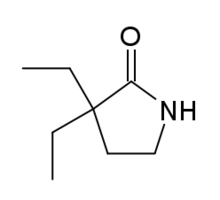
3,3-Diethyl-2-pyrrolidinone
3,3-Diethyl-2-pyrrolidinone (DEABL) is an anticonvulsant drug most closely related to pyrithyldione and gabapentin.[1] It was found to extend lifespan in the nematode worms Caenorhabditis elegans.[2]
 | |
| Clinical data | |
|---|---|
| ATC code |
|
| Identifiers | |
IUPAC name
| |
| CAS Number | |
| PubChem CID | |
| ChemSpider | |
| ChEMBL | |
| CompTox Dashboard (EPA) | |
| ECHA InfoCard | 100.162.031  |
| Chemical and physical data | |
| Formula | C8H15NO |
| Molar mass | 141.210 g/mol g·mol−1 |
| 3D model (JSmol) | |
SMILES
| |
InChI
| |
  | |
References
- Hill, MW; Reddy, PA; Covey, DF; Rothman, SM (1998). "Contribution of subsaturating GABA concentrations to IPSCs in cultured hippocampal neurons". Journal of Neuroscience. 18 (14): 5103–11. PMID 9651194.
- Evason, K; Huang, C; Yamben, I; Covey, DF; Kornfeld, K (2005). "Anticonvulsant medications extend worm life-span". Science. 307 (5707): 258–62. doi:10.1126/science.1105299. PMID 15653505.
This article is issued from
Wikipedia.
The text is licensed under Creative
Commons - Attribution - Sharealike.
Additional terms may apply for the media files.