Nerisopam
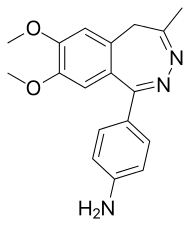
Nerisopam (GYKI-52322, EGIS-6775) is a drug which is a 2,3-benzodiazepine derivative, related to tofisopam. It has potent anxiolytic and neuroleptic effects in animal studies.[1][2][3]
 | |
| Clinical data | |
|---|---|
| ATC code |
|
| Identifiers | |
IUPAC name
| |
| CAS Number | |
| PubChem CID | |
| ChemSpider | |
| UNII | |
| ChEMBL | |
| CompTox Dashboard (EPA) | |
| Chemical and physical data | |
| Formula | C18H19N3O2 |
| Molar mass | 309.36 g·mol−1 |
| 3D model (JSmol) | |
SMILES
| |
InChI
| |
  | |

See also
References
- Horváth K, Andrási F, Berzsenyi P, Pátfalusi M, Patthy M, Szabó G, Sebestyén L, Bagdy E, Körösi J, Botka P. A new psychoactive 5H-2,3-benzodiazepine with a unique spectrum of activity. Arzneimittelforschung. 1989 Aug;39(8):894-9.
- Horváth K, Andrási F, Botka P, Hámori T. Anxiolytic profile of girisopam and GYKI 52,322 (EGIS 6775). Comparison with chlordiazepoxide and buspirone. Acta Physiologica Hungarica. 1992;79(2):153-61.
- Palkovits M, Baffi JS, Berzsenyi P, Horváth EJ. Anxiolytic homophthalazines increase Fos-like immunoreactivity in selected brain areas of the rat. European Journal of Pharmacology. 1997 Jul 16;331(1):53-63.
This article is issued from
Wikipedia.
The text is licensed under Creative
Commons - Attribution - Sharealike.
Additional terms may apply for the media files.