Tezosentan
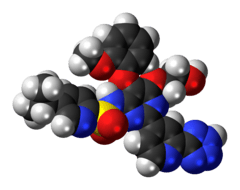
Tezosentan is a non-selective ETA and ETB receptor antagonist.[1] It acts as a vasodilator and was designed as a therapy for patients with acute heart failure. Recent studies have shown however, that tezosentan does not improve dyspnea or reduce the risk of fatal or nonfatal cardiovascular events.[2]
 | |
 | |
| Clinical data | |
|---|---|
| ATC code |
|
| Identifiers | |
IUPAC name
| |
| CAS Number | |
| PubChem CID | |
| ChemSpider | |
| UNII | |
| ChEMBL | |
| CompTox Dashboard (EPA) | |
| Chemical and physical data | |
| Formula | C27H27N9O6S |
| Molar mass | 605.624 g·mol−1 |
| 3D model (JSmol) | |
SMILES
| |
InChI
| |
| (verify) | |


References
- Urbanowicz, W; Sogni, P; Moreau, R; Tazi, K A; Barriere, E; Poirel, O; Martin, A; Guimont, M C; Cazals-Hatem, D; Lebrec, D (2004). "Tezosentan, an endothelin receptor antagonist, limits liver injury in endotoxin challenged cirrhotic rats". Gut. BMJ Publishing Group Ltd & British Society of Gastroenterology. 53 (12): 1844–1849. doi:10.1136/gut.2003.036517. PMC 1774327. PMID 15542526.
- "Tezosentan does not appear to improve symptoms for patients with acute heart failure". Medical Studies/Trials. news-medical.net. 7 Nov 2007. Retrieved 2007-11-24.
This article is issued from
Wikipedia.
The text is licensed under Creative
Commons - Attribution - Sharealike.
Additional terms may apply for the media files.