Quipazine
Quipazine is a piperazine drug used in scientific research. It is a moderately selective serotonin receptor receptor agonist, binding to a range of different serotonin receptors, but particularly to the 5-HT2A[1] and 5-HT3.[2]
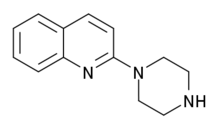 | |
| Clinical data | |
|---|---|
| ATC code |
|
| Identifiers | |
IUPAC name
| |
| CAS Number | |
| PubChem CID | |
| IUPHAR/BPS | |
| ChemSpider |
|
| UNII | |
| ChEMBL | |
| CompTox Dashboard (EPA) | |
| ECHA InfoCard | 100.164.885  |
| Chemical and physical data | |
| Formula | C13H15N3 |
| Molar mass | 213.278 g/mol g·mol−1 |
| 3D model (JSmol) | |
SMILES
| |
InChI
| |
  | |
See also
References
- Smith, R. L.; Barrett, R. J.; Sanders-Bush, E (1995). "Neurochemical and behavioral evidence that quipazine-ketanserin discrimination is mediated by serotonin2A receptor". The Journal of Pharmacology and Experimental Therapeutics. 275 (2): 1050–7. PMID 7473132.
- Cappelli, A; Anzini, M; Vomero, S; Mennuni, L; Makovec, F; Doucet, E; Hamon, M; Bruni, G; Romeo, M. R.; Menziani, M. C.; De Benedetti, P. G.; Langer, T (1998). "Novel potent and selective central 5-HT3 receptor ligands provided with different intrinsic efficacy. 1. Mapping the central 5-HT3 receptor binding site by arylpiperazine derivatives". Journal of Medicinal Chemistry. 41 (5): 728–41. doi:10.1021/jm970645i. PMID 9513601.
| Simple piperazines (no additional rings) |
|
|---|---|
| Phenylpiperazines |
|
| Benzylpiperazines | |
| Diphenylalkylpiperazines (benzhydrylalkylpiperazines) |
|
| Pyrimidinylpiperazines |
|
| Pyridinylpiperazines |
|
| Benzo(iso)thiazolylpiperazines | |
| Tricyclics (piperazine attached via side chain) |
|
| Others/Uncategorized |
|
This article is issued from
Wikipedia.
The text is licensed under Creative
Commons - Attribution - Sharealike.
Additional terms may apply for the media files.