Phenindione
Phenindione is an anticoagulant which functions as a Vitamin K antagonist.
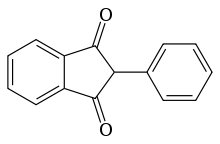 | |
| Clinical data | |
|---|---|
| AHFS/Drugs.com | International Drug Names |
| Pregnancy category |
|
| Routes of administration | Oral |
| ATC code | |
| Pharmacokinetic data | |
| Protein binding | 88% |
| Elimination half-life | 5 to 10 hours |
| Identifiers | |
IUPAC name
| |
| CAS Number | |
| PubChem CID | |
| IUPHAR/BPS | |
| DrugBank | |
| ChemSpider | |
| UNII | |
| KEGG | |
| ChEBI | |
| ChEMBL | |
| CompTox Dashboard (EPA) | |
| ECHA InfoCard | 100.001.323  |
| Chemical and physical data | |
| Formula | C15H10O2 |
| Molar mass | 222.239 g/mol g·mol−1 |
| 3D model (JSmol) | |
SMILES
| |
InChI
| |
| (verify) | |

Phenindione was introduced in the early 1950s. It acts similar to warfarin, but it has been associated with hypersensitivity reactions, so it is rarely used and warfarin is preferred.[1][2]
References
- Naisbitt DJ, Farrell J, Chamberlain PJ, et al. (June 2005). "Characterization of the T-cell response in a patient with phenindione hypersensitivity". J. Pharmacol. Exp. Ther. 313 (3): 1058–65. doi:10.1124/jpet.105.083758. PMID 15743920.
- Sean C Sweetman (Ed) (2009). Martindale: The Complete Drug Reference (36th ed.). London: Phamaceutical Press. "Phenindione", p. 1369.CS1 maint: extra text: authors list (link)
This article is issued from
Wikipedia.
The text is licensed under Creative
Commons - Attribution - Sharealike.
Additional terms may apply for the media files.