Miotine
Miotine is an anticholinesterase drug. Miotine was the first synthetic carbamate that was used clinically.[1]
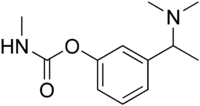 | |
| Names | |
|---|---|
| IUPAC name
[3-[1-(Dimethylamino)ethyl]phenyl] N-methylcarbamate | |
| Identifiers | |
CAS Number |
|
3D model (JSmol) |
|
| ChemSpider | |
| KEGG | |
PubChem CID |
|
CompTox Dashboard (EPA) |
|
InChI
| |
SMILES
| |
| Properties | |
Chemical formula |
C12H18N2O2 |
| Molar mass | 222.288 g·mol−1 |
Except where otherwise noted, data are given for materials in their standard state (at 25 °C [77 °F], 100 kPa). | |
  | |
| Infobox references | |

Unlike the miotine analog neostigmine, it doesn't have a quaternary ammonium group to give it a permanent positive charge. It can exist as an uncharged free base which could allow it to cross the blood–brain barrier and cause unwanted central nervous system (CNS) side effects.[2]
 Miotine equilibrium
See also
- Neostigmine
- T-1123
- TL-1238
References
This article is issued from
Wikipedia.
The text is licensed under Creative
Commons - Attribution - Sharealike.
Additional terms may apply for the media files.