Hexacyclonate
Hexacyclonate (Gevilon) is a stimulant drug. It has been used for the treatment of alcoholism[1] and for increasing motivation in elderly patients,[2] but is now mainly used for the treatment of hyperlipoproteinaemia. [3][4] It is chemically similar to the anticonvulsant gabapentin, with a hydroxyl group replacing the amine.
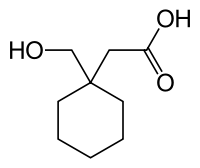 | |
| Identifiers | |
|---|---|
IUPAC name
| |
| CAS Number | |
| PubChem CID | |
| ChemSpider | |
| UNII | |
| ChEMBL | |
| CompTox Dashboard (EPA) | |
| Chemical and physical data | |
| Formula | C9H16O3 |
| Molar mass | 172.222 g·mol−1 |
| 3D model (JSmol) | |
SMILES
| |
InChI
| |
| (verify) | |


The latter use may be incorrectly assigned, as "Gevilon" has been used as a trade name for gemfibrozil, a well-known drug for dislypidemia.
References
- Chesrow, EJ; Sabatini, R; Musci, JP; Kaplitze, SE; Marquardt, GH (May 1962). "Adjunctive treatment of the chronic alcoholic with hexacyclonate sodium". Illinois Medical Journal (121): 546–548.
- Morrison BO. Pharmaco-motivation of the geriatric patient: a preliminary report on hexacyclonate. Journal of the Louisiana State Medical Society. 1962 Jan;114:23-6.
- Milewicz A, Plamieniak Z, Bohdanowicz-Pawlak A. Therapeutic effect of gevilon in patients with hyperlipoproteinaemia. Polish Journal of Medicine and Pharmacy. 1992 Apr-Jun;24(2):91-5.
- Gazdikova K, Korecka P, Springer V, Gazdik F. Pharmacoeconomic aspects of patients treated by hemodialysis. Bratislavske Lekarske Listy. 2003;104(10):329-34.
This article is issued from
Wikipedia.
The text is licensed under Creative
Commons - Attribution - Sharealike.
Additional terms may apply for the media files.