Eutylone
β-Keto-1,3-benzodioxolyl-N-ethylbutanamine (Eutylone, bk-EBDB, N-Ethylbutylone) is a stimulant compound developed in the 1960s,[1] which has been reported as a novel designer drug.[2]
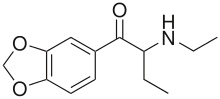 | |
| Clinical data | |
|---|---|
| ATC code |
|
| Legal status | |
| Legal status |
|
| Identifiers | |
IUPAC name
| |
| CAS Number |
|
| PubChem CID | |
| ChemSpider |
|
| UNII | |
| CompTox Dashboard (EPA) | |
| Chemical and physical data | |
| Formula | C13H17NO3 |
| Molar mass | 235.278 g/mol g·mol−1 |
| 3D model (JSmol) | |
SMILES
| |
InChI
| |
  | |

Legal status
Sweden's public health agency suggested classifying Eutylone as a hazardous substance, on September 25, 2019.[3]
References
- Substituted phenyl-α-amino ketones. British Patent GB 1085135 (1969).
- "Eutylone". New Synthetic Drugs Database.
- "Tretton ämnen föreslås klassas som narkotika eller hälsofarlig vara" (in Swedish). Folkhälsomyndigheten. 25 September 2019.
Empathogens/entactogens | |
|---|---|
| Phenylalkyl- amines (other than cathinones) |
|
| Cyclized phenyl- alkylamines | |
| Cathinones |
|
| Tryptamines | |
| Chemical classes | |
This article is issued from
Wikipedia.
The text is licensed under Creative
Commons - Attribution - Sharealike.
Additional terms may apply for the media files.