Butyltolylquinuclidine
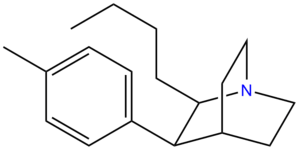
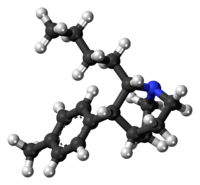
2-Butyl-3-(p-tolyl)quinuclidine (BTQ) is a stimulant DRI.[1] It is one of a number of substituted quinuclidine derivatives developed as potential medications for the treatment of cocaine abuse,[2] and produces similar effects to cocaine in animal studies, although milder and longer-lasting.
 | |
 | |
| Clinical data | |
|---|---|
| ATC code |
|
| Legal status | |
| Legal status |
|
| Identifiers | |
IUPAC name
| |
| PubChem CID | |
| ChemSpider | |
| Chemical and physical data | |
| Formula | C18H27N |
| Molar mass | 257.414 g/mol g·mol−1 |
| 3D model (JSmol) | |
SMILES
| |
InChI
| |
| (verify) | |
See also
References
- Sakamuri, S.; Enyedy, I. J.; Zaman, W. A.; Tella, S. R.; Kozikowski, A. P.; Flippen-Anderson, J. L.; Farkas, T.; Johnson, K. M.; Wang, S. (2003). "2,3-Disubstituted quinuclidines as a novel class of dopamine transporter inhibitors". Bioorganic & Medicinal Chemistry. 11 (6): 1123–1136. doi:10.1016/S0968-0896(02)00450-9. PMID 12614900.
- Enyedy, I. J.; Sakamuri, S.; Zaman, W. A.; Johnson, K. M.; Wang, S. (2003). "Pharmacophore-based discovery of substituted pyridines as novel dopamine transporter inhibitors". Bioorganic & Medicinal Chemistry Letters. 13 (3): 513–517. doi:10.1016/S0960-894X(02)00943-5. PMID 12565962.
This article is issued from
Wikipedia.
The text is licensed under Creative
Commons - Attribution - Sharealike.
Additional terms may apply for the media files.